
 EN
EN
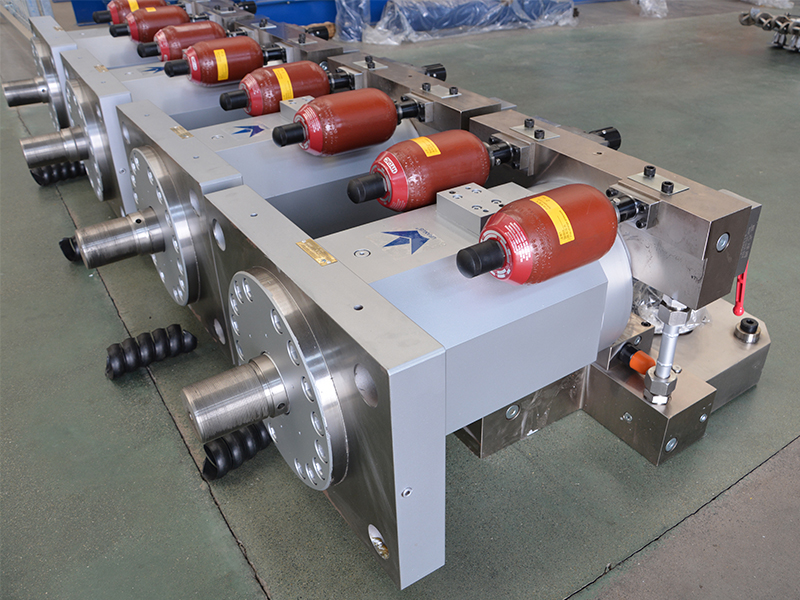
Why Integrate EHA with Servo Hydraulic Systems?
Energy and Control Limitations of Conventional Hydraulic Systems
Conventional hydraulic systems rely on fixed-speed pumps and throttling valves, leading to substantial energy waste—often 30–50% of input power—as excess flow is diverted or dissipated as heat. This inefficiency demands oversized cooling infrastructure and increases operational costs. Simultaneously, proportional valve-based control struggles to deliver the fine-grained, high-bandwidth motion profiles required for advanced automation tasks, limiting repeatability and responsiveness.
Core Synergy: Distributed Intelligence and On-Demand Power Delivery
Integrating Electro-Hydraulic Actuators (EHA) with servo hydraulic systems bridges these gaps. EHAs embed control intelligence directly at the actuator, eliminating long analog signal paths and reducing latency by up to 70%. Paired with a servo-driven hydraulic power unit—featuring variable-speed motors and pressure-compensated displacement—this architecture delivers power only when and where needed. The result is a responsive, adaptive system that dynamically matches flow and pressure to real-time load demands, cutting parasitic losses and enabling tighter integration with digital control ecosystems.
Energy Efficiency Gains in Hybrid Servo Hydraulic Systems
Servo pump technology vs. fixed-speed pumps: Real-time flow/pressure matching
Servo pump technology replaces fixed-speed drives with closed-loop, variable-frequency motor control—adjusting speed and displacement in real time to match instantaneous flow and pressure requirements. Unlike conventional systems that run pumps continuously at full speed, servo hydraulics scale power consumption linearly with workload. Independent studies, including those cited by the U.S. Department of Energy’s Hydraulic System Energy Savings Guide, confirm typical energy reductions of 30–50% across industrial duty cycles. Reduced fluid shear also minimizes heat generation, lowering cooling loads and extending fluid life.
| System Type | Energy Consumption | Response Time | Heat Generation |
|---|---|---|---|
| Fixed-Speed Pump | High | Slow | Significant |
| Servo Pump Technology | Adaptive | Instantaneous | Minimal |
Regenerative EHA designs: Recovering braking energy in cyclic operations
Regenerative EHAs capture kinetic energy during deceleration—converting it back into usable electrical energy via bidirectional motor-inverter topologies. In applications like press braking, robotic palletizing, or injection molding clamp cycles, this recovered energy can offset 15–25% of total drive energy demand. Crucially, regenerative operation reduces thermal cycling in valves, hoses, and seals, improving reliability and service intervals. As noted in ISO 4413:2010 (Hydraulic fluid power — General rules and safety requirements), such energy recovery aligns with best practices for sustainable system design without compromising functional safety.
Precision Motion Control Enabled by Integrated Servo Hydraulic Architecture
Decoupled multi-variable control via field-oriented motor drives and digital inverters
Integrated servo hydraulic architecture enables true decoupled control—separating torque, speed, and position regulation through field-oriented control (FOC) of the drive motor and synchronized digital inversion of hydraulic actuation signals. FOC dynamically aligns stator current vectors with rotor flux, minimizing torque ripple and maximizing efficiency across the entire speed range. Digital inverters execute microsecond-precision commutation updates, allowing hydraulic actuators to sustain sub-5-micron positioning accuracy—even during rapid reversals or under varying inertial loads. This capability is essential in high-value processes like carbon-fiber layup, semiconductor wafer handling, and precision optical polishing, where traditional valve-controlled systems introduce hysteresis, compressibility lag, and non-linear velocity profiles.
Industry 4.0 Readiness: Edge Intelligence and Adaptive Optimization
Balancing deterministic PLC execution with cloud-edge AI tuning in servo hydraulic loops
True Industry 4.0 readiness requires a layered control strategy: deterministic PLCs manage safety-critical sequencing and hard real-time motion commands (e.g., emergency stop, axis synchronization), while edge nodes process high-frequency sensor data—pressure, temperature, position, current—to adjust gains and compensate for drift within sub-millisecond windows. Cloud-based AI models then aggregate anonymized performance data from fleets of machines to refine predictive maintenance schedules, optimize energy profiles, and auto-tune PID parameters for new workloads. This hybrid architecture—validated in practice by manufacturers adopting IEC 61131-3 and OPC UA companion specifications—ensures robust, certifiable real-time behavior while enabling continuous, data-driven improvement—without requiring revalidation of core safety logic.
FAQ
What is an Electro-Hydraulic Actuator (EHA)?
An Electro-Hydraulic Actuator (EHA) is a self-contained system that integrates hydraulic actuator functionality with embedded control intelligence. EHAs eliminate latency and improve responsiveness in hydraulic systems.
How do servo hydraulic systems improve energy efficiency?
Servo hydraulic systems use variable-speed motors and real-time control algorithms to deliver power on demand. This reduces energy waste by scaling power consumption linearly with workload and lowering heat generation.
What are regenerative EHAs?
Regenerative EHAs capture kinetic energy during deceleration and convert it back into usable electrical energy, reducing total drive energy demands by 15-25% in cyclic applications.
How does integrated servo hydraulic architecture enable precision motion control?
Integrated servo hydraulic systems use field-oriented control (FOC) and digital inverters for decoupled control of torque, speed, and position, achieving sub-5-micron positioning accuracy.
What makes servo hydraulic systems Industry 4.0 ready?
Servo hydraulic systems integrate edge intelligence for real-time optimization and cloud-based AI for predictive maintenance and performance optimization, ensuring they meet Industry 4.0 standards.