
 EN
EN
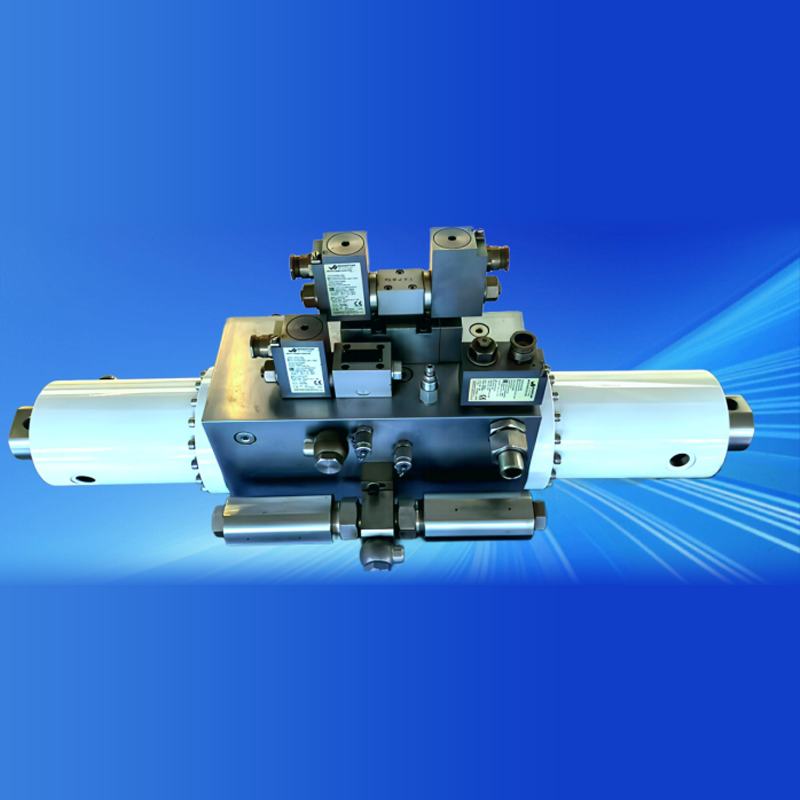
How Booster Cylinders Provide Consistent Pressure Amplification
The booster cylinder operates by dual piston force multiplication and hydraulic intensification.
A booster cylinder increases hydraulic pressure by means of mechanical and hydraulic methods, with no external energy source required. It contains two pistons of dissimilar diameters in one bore. A low-pressure fluid operates the larger piston, and the force is transmitted directly to the smaller piston. In this method, force is equal to pressure multiplied by area. A greater pressure is obtained when the force is applied to a smaller area. Cycle operation of this method is closed loop; when the large piston reaches the end of the stroke, an internal valve changes position to extend and retract the two pistons, thus resetting the system. An intensification of pressure of 2 to 10 times the original pressure is typical. The booster cylinder is optimized to serve a purpose that requires short bursts of high pressure (like clamping, testing, etc.) where a hydraulic pressure unit (which generates hydraulic pressure in the system) is operated in a range of elevated pressure.
Design pressure intensification ratio for required system output by balancing flow loss, response speed, and system interaction.
The ratio of pressure intensification is fundamentally a design trade-off between the output pressure and flow retention and responsive flow. Ratios of 5:1 will result in greater pressure but significantly lower output flow. For example, a booster with a 4:1 ratio and 1000 psi input will output 4000 psi, but the output will occur with one-quarter the input flow. This results in a longer refill and longer cycle time, and will slow down an automated system. On the other hand, a lower ratio of 2:1 will provide a much faster response time, and flow loss will be significantly reduced, but lower peak pressure will be the trade-off. Interaction with the system must also be verified; all seals, ports, and internal passages must be rated for the higher levels of pressure, and the system will not function with leakage or fatigue of those components. The engineers align the ratio with the duty cycle. Higher pressure ratios work for less frequent and shorter duration pressure demands, and a lower ratio is for pressure demands of continuous and rapid operation. It is critical the inlet pressure remains within the range of the manufacturer’s specifications to prevent cavitation or unstable cycling, which compromises the long-term reliability of the system.
Implementing a Booster Cylinder in Existing Hydraulic Power Units
To integrate a booster cylinder into an existing HPU, several interfaces must be addressed. These include the mounting, the control, and the consideration of hydraulics and mechanics.
The mounting requires the alignment of the cylinder flange and the HPU frame. Several design considerations need to be employed. These include the use of brackets to minimize vibration, the specification of the material, and the ensuring of torque to lessen the chance of misalignment and fatigue. Control integration requires that the PLC or relay logic be configured to respond to the booster’s stroke-end sensors, adjust the pressure switches, and install a pilot-operated sequencing control valve.
Several design considerations need to be employed. These include the use of brackets to minimize vibration, the specification of the material, and the ensuring of torque to lessen the chance of misalignment and fatigue. Control integration requires that the PLC or relay logic be configured to respond to the booster’s stroke-end sensors, adjust the pressure switches, and install a pilot-operated sequencing control valve. Additionally, the flows in the booster and HPU must be considered. These flows must be kept separate to avoid negative consequences to the internal seal of the booster. Oil degradation will result in tumor growth and premature failure of the internal seals. The system is designed to minimize downtime.
Sizing Major Parts for Booster Cylinder Functioning
Installing valves, filters, hoses, and seals that can operate under high pressure without cavitation, leaking, or fatigue failure
When operating booster cylinders target 5,000 psi, then every component both upstream and downstream of the cylinder must be certified for 5,000 psi. Directional and pressure control valves, rated for 3,000 psi, may leak at higher differentials, causing drift and inefficiency; replace them with valves rated for 3,750 psi. Filtering housings must be rated for 6,000 psi. Hoses and tubing must have a burst pressure of 20,000 psi. These specifications impede cavitation by ensuring adequate pump inlet pressure, clearing spool leakage, and fatigue of reinforcing materials of flexible lines. The seals must be PTFE with a backup ring.
Designing for Safety: Expanding Burst Pressure Margins, Creating Redundant Relief Paths, and Changing Procedures
High-pressure booster systems require proactive engineering rather than reactive engineering. First, all system components must be checked for margin of burst pressure. The industry sets the best practice threshold to be at least a 4:1 pressure ratio. For outputs at 6,000 psi, all piping and all valves and fittings must withstand at least 24,000 psi. Second, a redundant relief system must be designed. A primary relief valve should be set to open at 105% of system pressure, while a secondary valve should be set to open at 110% and should be vented to the tank. This allows a safe over-pressurization containment of the system in the case of a dead-end scenario in the booster or failure of the primary relief valve. Finally, manage the human element: operator protocols should be revised to include a pre-shift check to verify high-pressure isolation, lockout/tagout for the booster and relief valve pod, and the emergency shutdown steps to be clearly defined. Additionally, the high-pressure system should be checked at least once a year to conduct a hydrostatic test in order to identify any signs of fatigue. This testing must be done by a qualified third-party.
Booster Cylinder vs. Other Pressure Amplification
When comparing the alternatives for booster cylinders when upgrading legacy hydraulics versus other methods, booster cylinders offer significant benefits for high-pressure capabilities. Other alternatives (compared to booster cylinders) require high-pressure pumps, which come with large electrical, complex systems, large plumbing circuits, and complicated operational controls. Unlike other alternatives, booster cylinders use existing HPU technology and rely on passive, mechanical force multiplication. Using booster cylinders eliminates other energy concerns and large footprint and complex systems when compared to pressure intensifiers. Although hydraulic intensifiers can be useful for pressure amplification, they rely on a pulsed reciprocation mechanism. This causes flow discontinuity and vibration, which booster designs do not rely on a balanced, continuously operated mechanism. Pneumatic boosters do not function with hydraulic fluids for fundamental seal and material concerns. When pressure intensification is needed for pressure boosting, these boosters outperform methodology relying on pumps. The benchmark for fluid power often has fluid power booster cylinders with 40% less components compared with pump based alternatives, allowing for an upgrade for pressure boosting with little disruption to the existing hydraulic system.
Frequently Asked Questions (FAQs)
What is a booster cylinder used for?
Applications which require high pressure fluid for a short period of time, such as clamps, presses, and testing, use booster cylinders.
How does a booster cylinder work?
Force multiplication occurs through the booster cylinder when a low-pressure hydraulic fluid fills a larger cylinder and forces a smaller piston; this creates a higher pressure based on the area ratio as a result of this proportional transmission.
What is important when selecting a booster cylinder?
A higher intensification of pressure, system compatibility, flow retention, response time and a safe operation are all considerations when selecting a booster cylinder. This includes operation with the set limits of the inlet pressure.
Is it possible to add booster cylinders to older systems?
Yes, but it requires consideration of mounting and port sizing, fluid compatibility, and control along with the existing hydraulic power unit.
What is the basic level of maintenance required with booster cylinders?
Maintenance consists of checking the pressure rating of system components, ensuring cleanliness and the proper viscosity of the fluid, inspecting seals, and performing periodic hydrostatic tests.