
 EN
EN
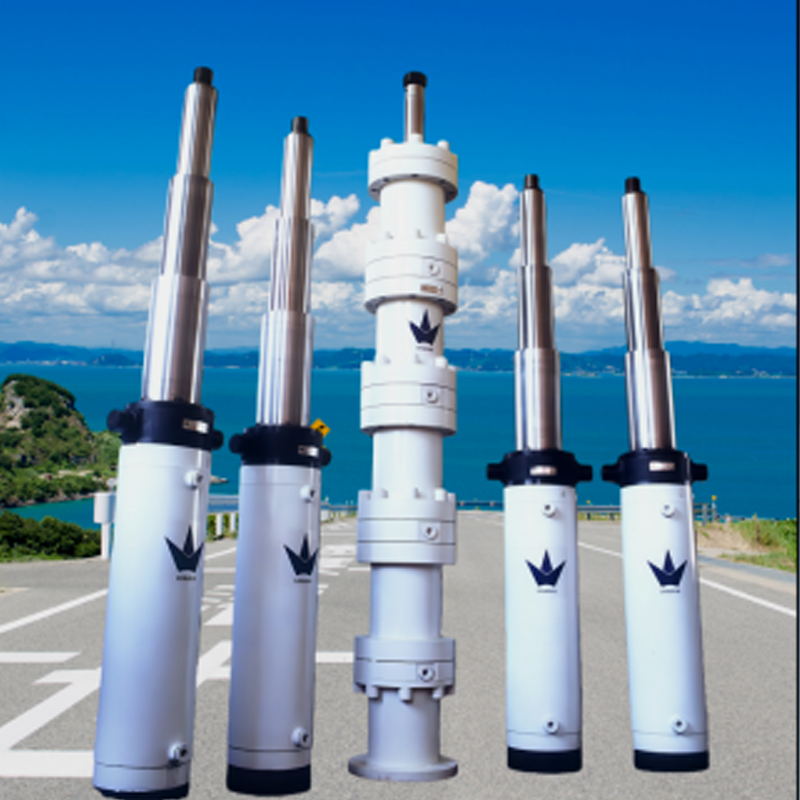
The Operational Demands Driving Long Service Life in Metallurgical Hydraulic Cylinders
Thermal Shock and Cyclic Loading in Continuous Casting Environments
In continuous casting, ladle turret rotary unions endure rapid temperature swings—from direct contact with molten steel to repeated cooling sprays—creating severe thermal shock that destabilizes standard seal compounds. Coupled with cyclic loading from each turret rotation, these conditions promote micro-cracking in cylinder components. Research from 2023 indicates uncontrolled thermal cycling can reduce seal integrity by up to 40% within the first 10,000 operating hours. To withstand this, metallurgical hydraulic cylinders must be engineered with thermally stable materials capable of repeated expansion and contraction without compromising dimensional accuracy.
Material Fatigue Accumulation Under 24/7 High-Temperature Operation
Unlike intermittent applications, non-stop operation in steel mills subjects hydraulic cylinders to sustained ambient temperatures above 200°F—accelerating material fatigue through creep in piston rods and thermal degradation of conventional elastomers. Industry data from 2022 shows standard cylinders under constant thermal load often fail by 15,000 hours due to fatigue cracking. Long-life designs counteract this with high-strength alloy selection and precision heat-treating processes, extending reliable service life toward the 50,000-hour benchmark.
Design Innovations That Extend Metallurgical Hydraulic Cylinders Beyond 50,000 Hours
Manufacturers now engineer metallurgical hydraulic cylinders to support more than five decades of continuous mill operation. Achieving 50,000+ hours demands two foundational innovations: a robust sealing architecture for rotary union interfaces and an advanced surface treatment that drastically reduces rod wear.
Dual-Barrier Sealing Architecture for Rotary Union Interface Integrity
The rotary union interface remains a critical failure point in ladle turret systems. Traditional single-seal configurations degrade rapidly under thermal cycling and particulate contamination. A dual-barrier sealing architecture employs two independent seal lines separated by an intermediate lubrication zone. This design prevents fluid migration, sustains consistent pressure across cycles, and accommodates minor misalignments caused by thermal expansion—ensuring leak-free operation over thousands of rotations.
Hard-Chrome + Ceramic Composite Rod Surface Treatment to Reduce Scuffing Wear by 62%
Cylinder rods in continuous casting environments face abrasive scale buildup and high-temperature oxidation—leading to scuffing wear that compromises rod finish and seal performance. A composite surface treatment combining hard-chrome plating with a ceramic top layer delivers exceptional hardness and corrosion resistance. Independent testing confirms this coating reduces scuffing wear by 62% compared to standard hard-chrome alone. The ceramic layer also lowers coefficient of friction, minimizing heat generation and further extending seal life—enabling long-term retention of tight tolerances essential for metallurgical reliability.
Rotary Union Integration: Solving Thermal Misalignment in Ladle Turret Systems
Balancing Precision Alignment with Dynamic Thermal Expansion Effects
Ladle turrets experience thermal gradients exceeding 300°C during casting cycles, resulting in asymmetric expansion that can misalign hydraulic rotary unions by up to 2.5 mm. Such misalignment induces seal extrusion and accelerates wear. Advanced rotary joint housings integrate expansion compensation chambers that allow controlled radial movement while maintaining hydraulic integrity. Using finite element analysis (FEA), engineers model thermal growth patterns to pre-offset mounting positions—holding alignment within ±0.1 mm throughout operational cycles. This approach reduces seal leakage by 72%, ensuring durability in the demanding reality of 24/7 steel production.
FAQs
What are the main challenges faced by metallurgical hydraulic cylinders?
Metallurgical hydraulic cylinders face challenges such as thermal shock, cyclic loading, material fatigue due to high-temperature operations, and abrasive scuffing wear in continuous casting environments.
How do manufacturers ensure a longer service life for hydraulic cylinders?
Manufacturers use thermally stable materials, dual-barrier sealing architectures, advanced surface treatments, and heat-treating processes to extend the service life of hydraulic cylinders beyond 50,000 operating hours.
What innovations improve hydraulic cylinder durability?
Key innovations include dual-barrier sealing architectures, composite surface treatments like hard-chrome with ceramic overlays, and rotary union designs with thermal misalignment compensation.